Full transcript
The Nether Scrolls
In the dawn of Faerûn, the Sarrukh emerged as one of five creator races, building empires across the continent. One of the empires, the Isstosseffifil Empire arose in the lands that would become Anauroch. As they expanded, the Sarrukh discovered shamans of chaotic races wielding mysterious magical lore in remote wilderness areas. The Sarrukh studied these primitive forms of magic, seeking to understand and catalog their arcane secrets. Their discoveries were consolidated into a series of tomes, preserving the accumulated wisdom of countless magical traditions.
Upon completion, these books were brought to Oreme, the magnificent capital of the Isstosseffifil Empire for study. The most magically gifted among the Sarrukh and their servitor races, studied and extrapolated the bounds of this newfound knowledge. These are penned in the Golden Skins of the World Serpent, otherwise known thousands of years later as the Nether Scrolls. Isstosseffifil fell in a catastrophic war with the Phaerimms. In their final gambit, the desperate Sarrukh rerouted the Narrow Sea to flood the Phaerimm’s home in the Underdark. However, the resulting climate change doomed their own realm.
The surviving Sarrukh of Isstosseffifil retreated into lichdom, surviving through undeath. In Oreme’s depths, they sleep safely to this very day, protected by the Asabi race they created.
The First Age
The First Age. Netheril’s history began nearly 5,000 years ago, when seven fishing villages joined together for mutual defense and beneficial trade. They christened their tiny new realm, the Alliance of Seventon, in honor of the seven villages. Nether the Elder, shaman king of one village, emerged as leader and renamed the land Netheril, or Nether’s land. In time, he became a tyrant concerned only with power and position, ruling through fear. He was assassinated by his son, Alandril Nether the Younger, who succeeded him as king.
The Netherese chose a new form of government based loosely on democracy, with village leaders having one vote each, while the king’s vote is worth five. During this period, the Netherese began studying magic under moon elf ambassadors from Eaerlann. The elves saw promise in Netheril, and sought to nurture it as an ally against the orc hordes. Another, who recognized the potential of the Netherese, was the mysterious archwizard known as the Terraseer.
He appeared centuries after the elves, and began to instruct the Netherese in magic unknown to, or rejected by the elves. Unknown to the Netherese, the archwizard Arthindol the Terraseer was a Sarrukh lich from Isstosseffifil. The once great empire is now only left with the buried city of Oreme, and what caverns its inhabitants could hold against the Phaerimms. The sixty Sarrukh liches of Oreme take turns ruling their tiny realm, each emerging from hibernation to take the throne for four years, then returning to slumber in the Crypt of Dreaming Lizards when the next lich awakens.
The Terraseer adopted human form to make periodic visits to Netheril during his rule. He sought to shape Netheril’s evolution and cultivate new forms of magic that might enable the Sarrukh to defeat the Phaerimms once and for all. The Nether Age.
The Nether Age
In Netheril Year 326, the discovery of a set of 100 scrolls marked the most important dates in Netheril’s history. These scrolls provided the Netherese with an incredible advancement in spellcraft, unseen in the history of Toril. The person who unearthed the scrolls was only referred to as Finder. With the aid of a serpent-skin tome given to him by the mysterious Terraseer, he explored many ruins of the fallen Sun Elven Empire of Aryvandaar. In ruins west of Far Horns Forest, Finder discovered scrolls of gold.
Returning to Netheril and studying the scrolls, he realized he had found something worth far beyond the scroll’s monetary value. Finder discovered the hundred pages were two sets of 50 scrolls, one older than the other. He shared the scrolls with Netheril’s arcanists, calling the golden foils the Nether Scrolls, named after the nation of his birth. Within decades, Netherese arcanists’ understanding of magic advanced by incredible leaps and bounds.
However, half the Nether Scrolls, one complete set, were stolen towards the end of the Nether Age. The thieves were sent by Cormanthyr’s high mages. Alarmed by Netheril’s rapid mastery of the magical arts, they sought to study the texts that had brought about such dramatic advances, before Netheril could threaten Cormanthyr. The Nether Scrolls were hidden in the depths of Windsong Tower of Cormanthor. They were divided into five sets of ten, each changed into a golden beech tree. These trees formed the Quess’Ar’Teranthvar, also known as the Golden Grove of Hidden Knowledge. The Mythallar Era.
The Mythallar Era
With the Nether Scrolls’ discovery, the Netherese concentrated entirely on advancing their magic. The Netheril Year 544 marked the birth of Ioulaum, one of the greatest human archwizards, and one of the longest-lived creature known. Ioulaum was a major catalyst for Netherese spellcraft. In Netheril Year 845, Ioulaum created the Mythallar, a magical device that can access raw, unfiltered magic from the Weave itself. Before the Mythallar was invented, creating magical items require a permanency spell that drained the creator’s vitality severely.
Arcanists who made multiple permanent magical items appeared much older and bent than their years. With the advent of the Mythallar, Arcanists were able to create magical items that would, in effect, be permanent incantations as long as they stayed within the one-mile radius effect of the Mythallar. The first quasi-magical item was created by Ioulaum, an elaborate mantle granting dark vision and telepathic abilities. This item opened the floodgates, and Netheril was suddenly flushed with a glut of powerful quasi-magical items.
In Netheril Year 866, Ioulaum, tired of fighting orcs, goblins, and others who wanted to feed off the toils of the Netherese, put the Mythallar to a greater use. He sheared off a mountain summit with an 11th-level spell, suspending the mountaintop point down in the air, and set a Mythallar atop it, turning it into a quasi-magical, floating city foundation. On the flat side of the peak, he constructed a city. He named this structure Ioulaum’s Enclave, and soon, people from all across Netheril flocked to him, wanting to live in the clouds, high above the threats on the ground.
As the creator of Ioulaum’s Enclave, the archwizard was in absolute control. He allowed the people in the city to have a say, but when it came to the decisions, Ioulaum made them all. Every elite arcanist began striving to construct their own Mythallar and their own floating city. Enclave after enclave rose up into the sky, dividing the Netheril Empire into High and Low Netheril. High Netheril consisted of the floating cities occupied by the archwizards and their servants, and Low Netheril encompassed the lesser arcanists, the towns of the free folk, and the barbarian tribes that roamed the northern and southwestern plains.
The Silver Age
The Silver Age. Badly in need of resources, the Netherese sent scouts throughout the region to seek mining opportunities. During this push, the Netherese began setting up small colonies and outposts throughout what was later the Savage Frontier. Their primary source of raw materials was discovered when Dekanter, a Netherese miner, unearthed a huge lode of rare metals. For over 1,000 years, the Mine of Dekanter provided Netheril with more mineral wealth than any other location.
As more cities rose into the air, the archwizards feared their numbers would grow till the sun was blotted out from the surface. Feeling cramped within their borders, the archwizards debated on expansion and subjugating the eastern nations. But the Terraseer led an expedition of arcanists westward instead. The expedition returned with reports that amazed the Netherese, and plans to infiltrate the eastern cultures were laid to rest. “To allow this land to be dominated by mindless savages would be a crime against progress and enrichment.”, cried the Terraseer.
He urged Netheril to establish outposts in the western frontier, controlled loosely by barbaric tribesmen. The Terraseer found an ideal outpost location that could provide water for caravans entering the mineral-rich mountains. Unknown to the Netherese, the Terraseer had a hidden agenda. Beneath the site was an ancient Sarrukh vault built in the waning days of Isstosseffifil. It stored a large supply of chardalyns, gems that could hold a single spell cast into them and release the spell when crushed.
But the captive deepspawn, an aberration that could spawn many other varieties of monsters, guarded the vault too well. The constant stream of magical beasts it disgorged made the region too dangerous to settle. The Terraseer sought an empire with enough might to overcome the dangers and recover the chardalyns. At great military cost, the Netherese destroyed wave upon wave of beasts, eventually succeeding in establishing the outpost they named Quesseer.
The Netherese then tracked the remaining beasts back to the deepspawn and defeated it. They recovered an unimaginable supply of chardalyns. This “chance” discovery led to research into gem magic, which may have been the Terraseer’s intent all along. Less than three centuries later, Quesseer was abandoned. Since then, Old Owl Well, as the outpost’s well is called, has served as an excellent water source for passing caravans. The Golden Age.
The Golden Age
The distinction between the Silver Age and Golden Age is an arbitrary one. Most sages agree that Netheril’s Golden Age began with the birth of Jeriah Chronos, otherwise known as the Chronomancer, in Netheril Year 1652. During this age, another 24 of the Nether Scrolls were stolen. Fearful of the archwizard’s retribution, the thieves pounded the priceless golden scrolls into indiscernible baubles, then sold these gold nuggets for 260 gold pieces. By this time, dozens of floating cities soared above Netheril.
The Empire of Magic became the preeminent magical civilization of its time, and perhaps in the history of Faerûn. Its achievements only made its decay and downfall all the more tragic. The common people’s voices were drowned out by the archwizards’ lust for more power. Each archwizard ruled like a god, believing the deities were merely archwizards who found “ultimate magic” and could be challenged. The enclaves became the archwizards’ vehicles to acquire more raw materials and territory.
The flying cities became airborne platforms that launched deadly attacks against Netheril’s enemies. The Empire had reached the height of its power. The Shadowed Age.
The Shadowed Age
The birth of Karsus marks the beginning of the Shadowed Age in all histories of Netheril. A genius of Ioulaum’s caliber, he became the youngest archwizard ever at the age of 22. To gain the title of archwizard, one had to create a Mythallar, carve an enclave from a mountain, then erect his own city upon it. However, businesses and residences did not come to Karsus’s Enclave due to his youthfulness. He decided that if magical might alone couldn’t attract citizens to his enclave, perhaps an image of success would. Karsus hired the best architects to create buildings defying gravity, attracting citizens through architectural wonder. He also erected some of the greatest arcanist colleges and universities in Netheril.
To ensure even greater success, Karsus persuaded Seventon’s council to loan him the remaining Nether Scrolls for critical study. Unfortunately, enroute to Karsus’s Enclave, the caravan was ransacked and the scrolls were stolen. Netheril now had none of the Nether Scrolls in its possession, and their whereabouts perplexed even the greatest arcanists and seers. Karsus’s Enclave continued to attract controversies when a student in an academy named Telamont Tanthul published a highly criticized work on the planes. His work earned him the enmity of the establishment, and he was sent into exile. Studies of demiplanes was banned in several cities.
In Karsus’s Enclave, though, Karsus felt Telamont was onto something important, and Telamont was asked to stay and continue his planar studies. Telamont invited other underground researchers to help him in his investigation, and Karsus financed the whole operation. Eleven years later, Telamont published his work on the Demiplane of Shadow with Karsus’s permission. Archwizards throughout the nation realized the importance of this discovery. The Demiplane of Shadow could be exploited for shadow magic and shadow servants.
They lifted the ban on demiplane research, encouraging all others to discover more demiplanes. Archwizards and researchers were not the only ones who left a lasting impression on history. Unlike Telamont, an arcanist named Olostin was never given the opportunities that he felt he should be given. He lashed out angrily, citing his people’s slaughter and the enslavement of anyone not born Netherese. Ostracized by the Netherese, Olostin departed the empire.
Seeking a safe haven, he ventured underground, eventually meeting a subterranean creature that called itself a Phaerimm. This fateful meeting was the beginning of the end for Netheril. Befriending the human as a peaceful and concerned race, the Phaerimm claimed that some unknown force on the surface world was killing its children and elderly. It wanted to know who upon the surface was using magic. Olostin sat and told the creature of the decadent and brutal Netherese.
Without realizing his mistake, the arcanist revealed closely guarded secrets, including the existence and uses of the Mythallar. The Phaerimm race have only one goal, the eradication of all other beings in Faerûn. After Olostin departed, the evil creatures began researching and planning ways to sap the strength of the human nation. The Phaerimms raided Netherese outposts and outlying settlements, stealing magical knowledge to turn against their chosen enemy.
Their savage attacks left no survivors, leaving no clue on who was behind these murderous incidents. Eventually, the Phaerimms captured a Mythallar. Using the Mythallar as a model, the Phaerimms created their own version of an arcane device to access the Weave directly, and the true war began. The Phaerimms directed terrible life-drain spells at the Empire’s fertile lands.
Large tracts of Low Netheril slowly became sandy, useless deserts, as the spells leached life from the land itself. Netheril’s alarmed arcanists searched for the cause, while striving to limit the damage with their own powerful spells. By the time they identified the intelligence behind this phenomenon, vast sections of their home had succumbed to the Phaerimm assault. As the Empire prepared to defend itself, Phaerimms began their open attack. The Phaerimms’ continual bombardment of life-drain spells increased the area of desertification, eventually forming the barren waste of the Anauroch Desert. The Netherese responded in kind, raining arcane destruction upon the Phaerimms and their underground homes. Neither side could gain an advantage, both suffering tremendous losses. The war raged out of control, each side determined to extinguish the other. Karsus’s Folly.
Karsus’s Folly
Using his epic spell, Ioulaum’s longevity, Ioulaum of Seventon lived for centuries throughout most of the Netherese era. When the Phaerimms arrived, however, their life-drain spells caused his life-sustaining magic to fail. Foreseeing the doom of Netheril, Ioulaum left the Empire. Panic surged through Netheril as the citizens learned of Ioulaum’s disappearance, and the remaining archwizards feared that there would be a revolt. When the nature of the Phaerimms’ life-drain spells became known, Karsus felt the responsibility for Netheril’s future on his shoulders, a duty to weld the nation together.
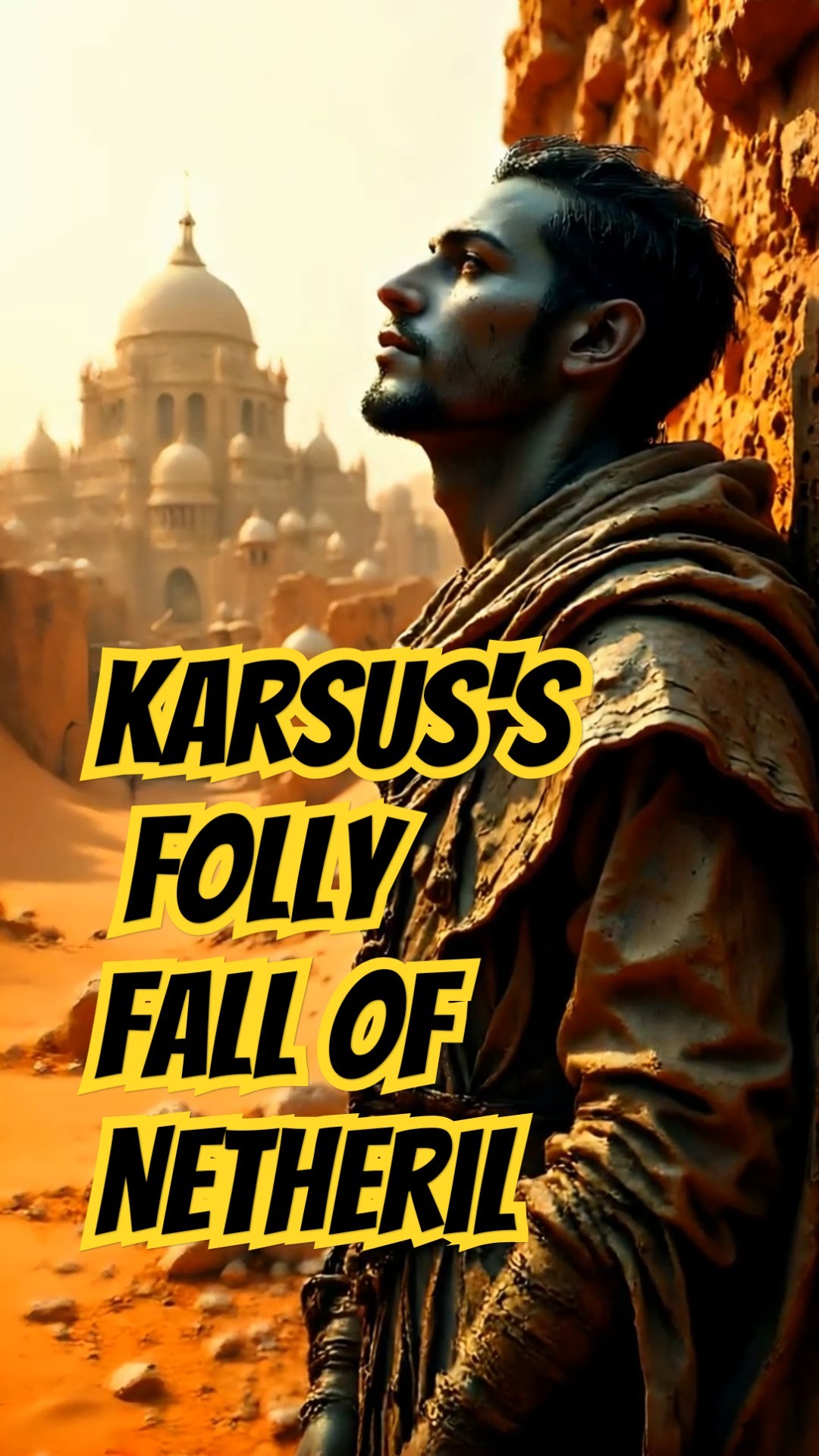
He began work on a spell to save his people. Without a doubt, it is the mightiest arcane magic ever wielded by a mortal in the history of Faerûn. This spell named Karsus’s Avatar, the only 12th-level spell ever created, could temporarily steal a deity’s power. With Ioulaum’s disappearance and panic surging in the Empire, Karsus finished the spell and casted it upon himself. He targeted Mystryl, the Goddess of Magic, and planned to destroy the Phaerimms and end their threat forever with her divine might.
Swelling with godly power, Karsus’s mind was filled with unimaginable knowledge, and he instantly realized his horrible mistake. He stole the power of the one god he shouldn’t have. The goddess, Mystryl constantly reworks the Weave that Netherese and Phaerimm spells continually threaten to unravel. When Mystryl lost her ability to keep the Weave intact, magical inundation surged and all things magical doubled briefly. Before the damage to the Weave became irreparable, Mystryl sacrificed herself to break Karsus’s link to her.
Her sacrifice saved the Weave, but caused all magic to briefly cease functioning. Karsus was instantly slain, his bloated body petrified and plummeted. Without magic, Netherese floating cities fell. Karsus’s stony eyes, still shimmering with godly omniscience, witnessed Netheril cities smashing to earth. His heart broke as he saw his home, family, friends, and people destroyed by his greed for divine power. Karsus’s Folly had done what the Phaerimms had been unable to do.
The Netherese Empire was no more. Mystryl reincarnated herself as Mystra, the new Goddess of Magic. She recreated the Weave with more rules and restrictions, and no spell above tenth level would function again. By the time she was completed, she was able to save only three of Netheril’s floating cities. Anauria, Asram, and Hlondath were high enough above the ground to survive. The rest were utterly destroyed. The cities landed along Netheril’s southeastern frontier, saved by the grace of Mystra.
The enclaves’ survivors built realms of the same names in the remaining fertile lands between the spreading sands of Anauroch and the Desertsmouth Mountains. All that remained of Netheril was destroyed over 300 years. In Netheril Year 3826, Asram was completely decimated by a plague unleashed by the goddess Talona in a battle with her rival Kipyutto. Asram’s ruins remained silent and abandoned ever since, as the plague still clings from Talona’s touch.
In Netheril Year 3970, Anauria fell to a massive orc attack. In Netheril Year 4188, the spreading Anauroch Desert consumed Hlondath’s fields, starving its people and sending them scurrying into the rest of Faerûn. The Sharns.
The Sharns
It was unusual that Anauroch ceased spreading with Hlondath’s fall, suggesting external magical intervention. Many believe Netherese arcanists transformed themselves into Sharns to combat the Phaerimm. Sharns have always opposed the Phaerimms, but they have not seek allies in their cause. They are ancient aberrations with an instinctive abhorrence to the abuse of magic, making it their calling to be the custodians of the Weave. They send scouts throughout Faerûn to observe and strike against those wielding magic for mass destruction, but when they cannot prevent such atrocities, they preserve dying cultures by permitting individuals of the doomed civilization to join their collective.
The Sharns fought great wars against the Phaerimms. Eventually, the spells of the Sharn halted the Phaerimm’s life-drain spells, and somehow confined the Phaerimm under the area that they had already devastated. This area of Underdark beneath the Anauroch Desert is now called the Buried Realms. It is bounded by the Sharn Wall. No other creature is impeded by this tremendous barrier, but the Phaerimm cannot pass through despite their magical knowledge.
The Phaerimm call their prison caverns the Phaerlin, which they rule through mind-controlling spells. Those who enter the Buried Realms are known to have fallen under the charms and suggestions of the Phaerimm within minutes. The Phaerimms work tirelessly to overcome the Sharn Wall, using magically influenced agents to reach beyond their prison. These agents bring back whatever magic they can seize and spread rumors of rich treasure to attract surface dwellers to the Phaerlin. Where is Ioulaum?
Where is Iolaum
Ioulaum established a lair in the depths of the Northdark and embraced lichdom after he left Netheril. After Netheril’s fall, Ioulaum quietly continued choosing apprentices from the most promising refugees. Curiously, he also accepted illithid apprentices from the nearby mind flayer city of Ellyn’taal, and his illithid students who called themselves the Alhoon are believed to have been the first illithiliches. Ioulaum’s intentions became clear when he created an undead elder brain from the minds of his illithid students and then merged his own sentience into it. He survives today as an undead elder brain known as the Oracle of Ellyn’taal.
The City of Shade
The City of Shade. A single Netheril flying city named Thultanthar, or Shade in the Netherese language, escaped the catastrophe purely by happenstance. The city’s ruling noble was none other than Telamont Tanthul, the arcanist Karsus sponsored to study the demiplanes. For some time, Telamont had been experimenting with movement between Faerûn and the Plane of Shadow. His studies eventually enabled him to move not only himself freely between the two, but other people and objects as well.
Known by many as Lord Shadow, Telamont had contemplated moving an entire flying city into the Plane of Shadow for some time. Days before Karsus cast his spell, he gave the order for the city to prepare itself for the experiment. On the eve of the disaster, Telamont transported his entire city and inhabitants to the Plane of Shadow. He was pleased to see that the city and its citizens suffered no immediate ill effects from the journey. However, he was dismayed that for some reason, he was unable to move the city back to Faerûn.
Unraveling this mystery took weeks, and when the city returned to Netheril, its inhabitants were horrified by Netheril’s destruction. For days, the city searched desperately across Netheril’s ruins for survivors, but none was found. Presuming this hideous revelation to be the work of the hated Phaerimms, the Netherese thirsted for revenge. Telamont realized, however, that a single flying city was no match for the Phaerimms. Moreover, his city’s Netherese might be the last of their entire race, and he could not risk losing his city and subjects as well.
Vowing that one day the city would return to Faerûn and re-establish the ruined empire, Telamont transferred his city back into the Plane of Shadow. Through unforeseen circumstances, the city remained in the plane for far longer than planned. The refugees, who call themselves Shadovars, maintained their culture throughout the centuries. They mastered shadow magic, and the city’s noble rulers became suffused with the dark energy of their new home. The City of Shade returned to Faerûn abruptly in 1372 DR, appearing over Dire Wood.
Proceeding to Anauroch, the Shadovars established the Empire of Shadows, claiming the entire desert as their rightful territory. Many eyes are turned toward Anauroch, and the strange city that looms in its sky, hoping for some sign of the Shadovars’ intent, and for sufficient warning should the city’s return prove the prelude to a war of conquest. For they are nothing less than a piece of living history, representing Faerûn’s most advanced arcane nation with magical knowledge unseen since its destruction. Hiding behind a veil of secrecy on their return, they are gathering power once more.